Can You Upload Diamonds That Are Maturing
If you're thinking of ownership a colored diamond, you'll want to know if its colour is natural or is the consequence of a treatment process.
Humans have been treating diamonds to enhance their appearance for centuries. There is nothing inherently incorrect with treating diamonds to change their colour– equally long as the treatment and whatsoever special care requirements are disclosed. The trouble arises when treatments are not disclosed, considering in such cases, yous think you are purchasing one thing simply are actually buying something else. Since diamonds are expensive and often emotionally symbolic, ownership a misrepresented one is no small matter.
The 104.53 ct Deepdene is 1 of the most notorious examples of a famous treated diamond – and what happens when the truth is discovered. In the mid-1950s, the Deepdene was irradiated and then heated to intensify its yellowish hue. However, this information was not provided to Christie's sale house when it was consigned and sold in 1971. GIA confirmed that indeed, it was treated and the sale was rescinded. The treater eventually came forward and confirmed that the stone was treated.
A number of processes tin can be used to alter the color of a diamond. Hither are some of the more than common treatment methods:
- Paints and coatings:
In the 1568 treatise of Benvenuto Cellini, the Italian goldsmith and sculptor boasted how he could enhance the color of yellowish diamonds past using indigo, a bluish dye. Modern advanced variations employ thin film coatings to create diamonds of all colors. Low-tech variations include nail smooth and permanent markers.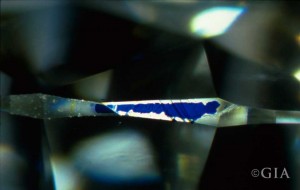
A small amount of blue coating on a yellow diamond can neutralize its bodycolor and make it appear more colorless. Photo by John I. Koivula/GIA.
- Irradiation and heat:
Scientists began irradiating diamonds over a century ago; their early experiments produced radioactive gemstones and color changes that were bars to thin zones well-nigh the surface. Neutron irradiation in a reactor and high-energy electron irradiation in a particle accelerator are now the nigh common handling methods. Heating irradiated diamonds to in a higher place 500o C will modify nigh blue-to-light-green colors to brownish or orangy yellow to yellow, or, in rare cases, pink to ruby. - High-force per unit area high-temperature (HPHT) annealing:
Exposing diamonds to very high pressures and temperatures can lighten the colour of some brownish diamonds. In some instances, information technology tin can besides be used to create certain fancy colors. It is the about mutual treatment method used to create treated yellow diamonds.

HPHT treatment can produce a wide range of colored diamonds.
- Low-Pressure, Loftier-Temperature Annealing:
Oestrus treatment under low pressures can be used to create blackness diamonds by causing graphite to course in surface reaching fractures. The procedure is so commonplace, that black diamonds treated this mode are more than prevalent that natural color black diamonds.
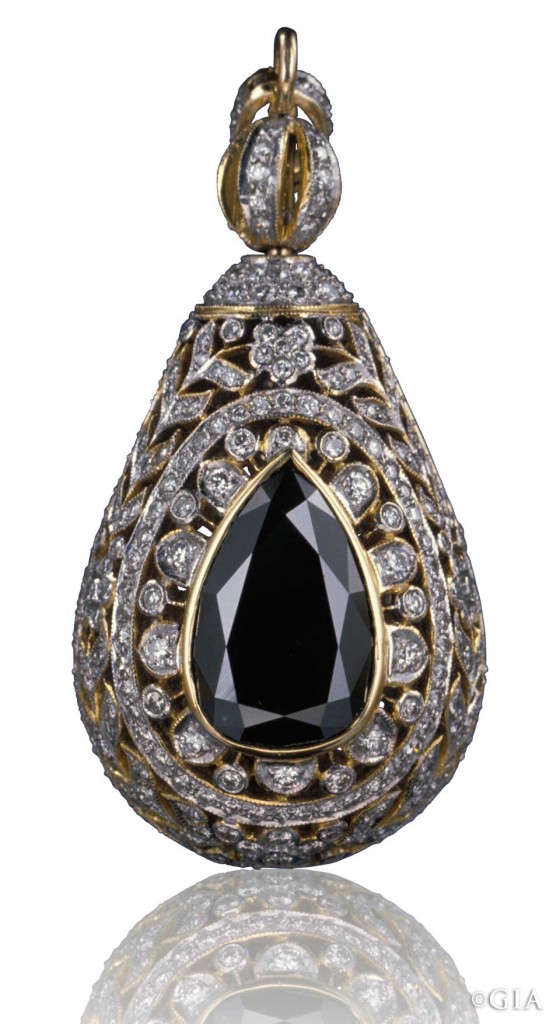
The approximately 5.75ct "black" diamond in the pendant is a slightly radioactive laboratory-irradiated very night greenish diamond. Photograph Shane F. McClure/GIA.
Shown below examples of the wide range of treated-color diamonds now bachelor on the market. Colors across the entire visible spectrum are now doable with the proper starting material and combination of treatments.

A wide range of treated-color diamonds at present available on the market place. Photo by C.Chiliad. Breeding/GIA.
The 3 diamonds at the center of the diagram are the less-valuable starting colors that are virtually often used for colour handling processes. In addition, this diagram groups colors by the treatment methods.
Detecting diamond color treatments often requires sophisticated testing and instrumentation, the kind you find only in the best equipped laboratories like the GIA Laboratory. Whether a diamond's color is natural or artificially induced can virtually ever be determined. In rare cases, such equally with some green diamonds, existing precious stone identification techniques and testing equipment cannot positively make up one's mind the source of colour and the GIA Lab will annotation the color origin as undetermined.

All of these colored diamonds (0.12-i.38 ct) were treated by irradiation and, except for the black, blue and green stones, subsequent heat handling. Photo by Robert Weldon/GIA.
A GIA Colored Diamond Grading Report or Identification and Origin Study will tell you if the color in the diamond yous're eyeing is natural or treated, helping you lot make the purchase with total peace of mind.
Source: https://4cs.gia.edu/en-us/blog/changing-diamonds-color/
0 Response to "Can You Upload Diamonds That Are Maturing"
Post a Comment