Hellenic Literature and Art Offer Ample Evidence of Bisexual and Homosexual Relationships
HOMOSEXUALITY IN ANCIENT GREECE

Tomb of the Diver symposium Homosexuality in aboriginal Greek was tolerated and regarded as no big deal, and, by some, even considered even stylish. But plainly not everybody. Orpheus was dismembered past the Maenads for advocating homosexual love.
Among the Greeks homosexuality was common, specially in the military. Some have argued that homosexuality may have been the norm for both men and women and heterosexual sexual practice was primarily only to have babies.
Sexual contact occurred amid males in the bath houses. Gymnasiums, where naked men and boys, exercised and worked out together, were regarded every bit breeding grounds for human being-erotic impulses. At the extreme finish, members of Magna Mat cults dressed in women'south clothes and sometimes castrated themselves.
Some have argued that homosexual marriages of some kind were widely accepted in classical antiquity and that the medieval church building continued the pagan practice. There arguments though tend to be weak and based on anecdotal material. There is no proof that such marriages existed in Greek and Roman culture except among the elite in imperial Roman smart set. Other evidence of homosexual marriages come from isolated or marginal regions, such as postal service-Minoan Crete, Scythia, Albania, and Serbia, all of which had unique and sometimes bizarre local traditions.
In aboriginal times men sometimes made a pledge by putting their hands on their testicles equally if to say, "If I am lying you can cut off my balls." The practise of making a pledge on the Bible is said to take its roots in this practice.
Categories with related articles in this website: Ancient Greek History (48 articles) factsanddetails.com; Aboriginal Greek Art and Civilization (21 articles) factsanddetails.com; Ancient Greek Life, Government and Infrastructure (29 manufactures) factsanddetails.com; Ancient Greek and Roman Religion and Myths (35 manufactures) factsanddetails.com; Ancient Greek and Roman Philosophy and Scientific discipline (33articles) factsanddetails.com; Ancient Farsi, Arabian, Phoenician and Nigh Due east Cultures (26 articles) factsanddetails.com
Websites on Ancient Hellenic republic: Cyberspace Ancient History Sourcebook: Hellenic republic sourcebooks.fordham.edu ; Internet Aboriginal History Sourcebook: Hellenistic Earth sourcebooks.fordham.edu ; BBC Ancient Greeks bbc.co.uk/history/; Canadian Museum of History historymuseum.ca; Perseus Project - Tufts University; perseus.tufts.edu ; ; Gutenberg.org gutenberg.org; British Museum ancientgreece.co.united kingdom; Illustrated Greek History, Dr. Janice Siegel, Department of Classics, Hampden–Sydney College, Virginia hsc.edu/drjclassics ; The Greeks: Crucible of Culture pbs.org/empires/thegreeks ; Oxford Classical Art Research Heart: The Beazley Annal beazley.ox.ac.uk ; Aboriginal-Greek.org ancientgreece.com; Metropolitan Museum of Art metmuseum.org/about-the-met/curatorial-departments/greek-and-roman-art; The Aboriginal City of Athens stoa.org/athens; The Internet Classics Archive kchanson.com ; Cambridge Classics External Gateway to Humanities Resources web.archive.org/web; Ancient Greek Sites on the Spider web from Medea showgate.com/medea ; Greek History Course from Reed web.archive.org; Classics FAQ MIT rtfm.mit.edu; 11th Brittanica: History of Aboriginal Greece sourcebooks.fordham.edu ;Internet Encyclopedia of Philosophy iep.utm.edu;Stanford Encyclopedia of Philosophy plato.stanford.edu
Mary Renault'south " The Mask of Apollo" contains descriptions of romantic homosexual affairs.
Homosexuality, Education and Alexander the Keen
Alexander the Peachy probably had gay lovers. Although he was married twice some historians claim Alexander was a homosexual who was in love with his childhood friend, closest companion and general — Hephaestion. Another lover was a Persian eunuch named Bagoas. But many say that his truest love was his horse Bucephalas.
Relationships betwixt older men and teenage boys was believed to be mutual. In " Clouds" Aristophanes wrote: "How to exist small-scale, sitting and so equally not to expose his crotch, smoothing out the sand when he arose and so that the impress of his buttocks would not be visible, and how to be strong...The accent was on dazzler...A cute boy is a practiced male child. Education is leap upwards with male love, an thought that is role of the pro-Spartan credo of Athens...A youth who is inspired by his love of an older male will attempt to emulate him, the heart of educational feel. The older male in his want of the beauty of the youth volition practice whatever he tin can better information technology."
In Aristophanes'south " The Birds" , one older man says to another with cloy: "Well, this is a fine country of affairs, you demanded desperado! You lot encounter my son just as he comes out of the gymnasium, all ascent from the bath, and don't kiss him, you don't say a word to him, you don't hug him, yous don't feel his assurance! And you're supposed to exist a friend of ours!"
Homosexuality, Militarism and Sports in Ancient Hellenic republic

Homosexuality and athleticism were said to accept gone hand in manus in ancient Greece. Ron Grossman wrote in Chicago Tribune, "Far from finding homosexuality and athleticism mutually exclusive, they considered gay sexual practice an first-class training regimen and an inspiration for military valor." Plato said, "if there were only some manner of contriving that a land or an army should be made of lovers they would overcome the earth."
Homosexuality appears to take been the norm in ancient Sparta for both men and women with more than a bear on of sadomasochism thrown in. The Spartans believed that beating was skillful for the soul. Heterosexual sex was primarily just to have babies. Young boys were paired with older boys in a relationship that had homosexual overtones. Plutarch wrote: "They were favored with the society of young lovers among the reputable young men...The boy lovers also shared with them in their award and disgrace."
When a male child reached 18, they were trained in gainsay. At twenty they moved into a permanent barrack-way living and eating organisation with other men. They married at any fourth dimension, merely lived with men. At 30 they were elected to citizenship. Earlier a Sparta wedding , the bride was normally kidnapped, her pilus was cut brusk and she dressed every bit a human being, and laid downwards on a pallet on the floor. "And then," Plutarch wrote, "the bride groom...slipped stealthily into the room where his bride lay, loosed her virgin'southward zone, and bore her in his arms to the spousal relationship-bed. Then after spending a brusk time with her, he went away composedly to his usual quarters, there to sleep with the other men."||
The Sacred Band was an regular army unit and warrior caste from Thebes, northwest of Athens. Ranked 2d in fierceness after the Spartans and celebrated in the song "Boeotia", the region of Hellenic republic from which they were from,, they were ofttimes paired with theirs lovers nether the assumption they would fight harder for their lover than they would for themselves. Information technology was said they never were defeated in boxing until Greece lost its independence to Philip II of Macedonia. But fifty-fifty and so Philip was moved past their bravery. Plutarch wrote: "When after the boxing, Philip was surveying the dead, and stopped at the place where the 300 were lying and learned that thus was a band of lovers and beloved, he burst into tears and said, "Perish, miserably they who remember that these men died or suffered anything disgraceful."
Sappho and Lesbians in Ancient Hellenic republic

Alma-Tadema's view of a
adult female reading poetry Sappho wrote sensuously about love betwixt females. The word "lesbian" comes from her habitation island of Lesbos. Born in 610 B.C. in Lesbos, off of Asia Pocket-sized, she was probably from a noble family and her male parent was probably a vino merchant. Little is known about her because she didn't write much about herself and few others did.
In Sappho'southward time, Lesbos was inhabited by the Aeolians, a people known for free thinking and liberal sexual customs. Women had more freedom than they did in other places in the Greek world and Sappho is believed to have received a quality education and moved in intellectual circles.
Sappho formed a society for women in which women were taught arts such as music, poetry and chorus singing for marriage ceremonies. Although the relationship betwixt Sappho and the women in her society is unclear she wrote about love and jealousy she felt for them. In spite of this, she had a child named Kleis and may accept been married.
In his book "The Offset Poets", Michael Schmidt speculates on where she was born and raised on Lesbos: was it in the western hamlet of Eressus in crude, barren land, or in the cosmopolitan eastern seaport of Mytilene? He subtly evokes her poetic style: ''Sappho's art is to dovetail, smooth and rub downward, to avoid the over-emphatic.'' And he aptly compares the relationship between voice and musical accompaniment in Sappho'south performance of her poems to the recitative in opera. [Source: Camille Paglia, New York Times, August 28, 2005]
Over the centuries passionate arguments over Sappho's character, public life and sexual orientation have sprung upwards. Fifty-fifty though at that place is no direct reference to homosexual or heterosexual sex religious leaders — including Pope Gregory 8, who chosen her a "lewd nymphomaniac in 1073 — ordered her books burned.
See Sappho Under Verse Nether Literature
Hellenic republic a Homosexual Paradise?

Paul Halsall wrote in "People with a History: An Online Guide to Lesbian, Gay, Bisexual, and Trans History": "For mod western gays and lesbians, Ancient Greece has long functioned every bit sort of homosexual Arcadia. Greek civilisation was, and is, highly privileged every bit one of the foundations of Western civilization and the civilization of sexuality apparent in its literature was quite dissimilar from the "repression" experienced by moderns. The sense of possibility the Greek experienced opened upwards can be seen in a scene in E.1000. Forster'due south "Maurice" where the hero is seen reading Plato'due south Symposium at Cambridge.
"Information technology would exist besides simple, however, to see Greek homosexuality as simply a more idyllic form than modern versions. Every bit scholars have gone to work on the — plentiful — material several tropes have get common. 1 set up of scholars (slightly old-fashioned now) looks for the "origin" of Greek homosexuality, every bit if information technology were a new blazon of game, and argues that, since the literature depicts homosexual eros among the fifth-century elite, information technology functioned every bit sort of mode among that grouping. This is rather like arguing that because nineteenth-century English novels depict romance every bit an activity of the gentry and elite, other classes did not take romantic relationships.
"Another, now more than prevalent, grouping of scholars debate that term "homosexual", referring they say to sexual orientation, is inappropriate to discussions of Greek sexual worlds. Rather they stress the age noise in literary homoerotic ideals, and the importance of "agile" and "passive" roles. Some stress these themes then intently that it comes as a surprise to discover that we now know the names of quite number of long-term Greek homosexual couples.
"Every bit a result of such scholarly discussions, it is no longer possible to portray Greece as a homosexual paradise. It remains the case that the Greek feel of eros was quite unlike from experiences in the mod world, and nonetheless continues, because of Hellenic republic'southward persistent influence on modern norms to be of special interest."
Sources on Homosexuality in Ancient Greece
Paul Halsall wrote in a 1986 graduate schoolhouse paper titled "Homosexual Eros in Early on Greece": "Homer and Hesiod requite some thought of pre-archaic mores apropos erotic want. From the primitive menstruum itself we accept a wealth of erotic verse - Sappho, the lone female witness, Anacreon, Ibycus and Solon all writing lyric poetry and Theognis, whose elegiac corpus was later conveniently divided into political and pederastic sections. Classical sources include Aristophanes' comedy and some comments from Thucydides and Herodotus. Plato: writes frequently about eros, above all in the Symposium and Phraedrus but just as instructive are comments in other dialogues about Socrates relationships with a number of younger men. The spoken communication of Aischines against Timarchus gives a skilful example of oratory on homosexual acts from the 4th century." Another "group of sources are scraps of information we tin draw from the vocabulary used about erotic desire, information we have about laws and privileges in sure cities and mod prosopography that can identify phenomena like the homosexualisation of mythical persons which occurred in our period.
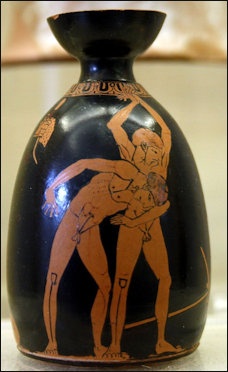
"Homer'south heroes have strong emotional bonds with each other but erotic want is directed at women. Achilles' love for Patroclus was seen later as homosexual but despite the effect of Patroclus' decease no physical relationship is mentioned. Hesiod is non much concerned with eros at all but he is clearly describing a country life where a man'south main finish was to produce sons. There have been attempts to say that homosexuality entered Greek civilization with the arrival of the Dorians. The wide acceptance of homosexuality in Dorian cities is cited every bit the grounds for this. Our earliest evidence of a culture of homosexual eros comes however from Ionian Solon and Aeolian Sappho rather than Dorian Tyrtaeus. It is non so a question of homosexuality coming from anywhere. What we have is a situation where early sources show no emphasis on homosexuality so fairly chop-chop toward's the stop of the 7th century the appearance of homosexual poems, followed on by vases and more poems in the early 6th century. The geographical extent of the phenomenon makes attempts to ascribe homosexuality to more leisure on behalf of the Athenian aristocracy untenable. Sparta was not at leisure nor many other cities with tyrannies where homosexuality was as adequate every bit in Athens.
"More testimony to homosexual Eros effect on culture can exist seen in the visual arts, both on vase decorations and in statues. Even when no homosexual run into is portrayed these works exhibit a strong appreciation of the male torso, much more than so than the female body which is often draped. It is legitimate to use these works to determine what the canons or beauty were. The primitive platonic was of a tanned muscled youth after the' onset of puberty but earlier a strong beard had grown. It was a dazzler formed by the particular physical instruction of Greek youth and is sympathetically parodied by Aristophanes every bit consisting of "a powerful breast, a salubrious skin, broad shoulders. a big arse and a small cock". Satyrs information technology may be noted are depicted equally reverse to this in every item."
Sodomy in Antiquity
Leonard C. Smithers and Sir Richard Burton wrote in the notes of "Sportive Epigrams on Priapus": Paedico ways to pedicate, to sodomise, to indulge in unnatural lewdness with a woman frequently in the sense of to abuse. In Martial's Epigrams x, xvi and 31 jesting allusion is made to the injury done to the buttocks of the catamite by the introduction of the 'twelve-inch pole' of Priapus. [Source: "Sportive Epigrams on Priapus" translation by Leonard C. Smithers and Sir Richard Burton, 1890, sacred-texts.com] Orpheus is supposed to accept introduced the vice of sodomy upon the earth. In Ovid's Metamorphoses: He also was the first adviser of the Thracian people to transfer their honey to tender youths ...presumably in consequence of the death of Eurydice, his wife, and his unsuccessful endeavor to bring her to world once again from the infernal regions. Simply he paid dearly for his contempt of women. The Thracian dames whilst celebrating their bacchanal rites tore him to pieces.
François Noël, however, states that Laius, father of Oedipus, was the showtime to brand this vice known on earth. In imitation of Jupiter with Ganymede, he used Chrysippus, the son of Pelops, as a catamite; an example which speedily institute many followers. Amid famous sodomists of antiquity may be mentioned: Jupiter with Ganymede; Phoebus with Hyacinthus; Hercules with Hylas; Orestes with Pylades; Achilles with Patrodes, and likewise with Bryseis; Theseus with Pirithous; Pisistratus with Charmus; Demosthenes with Cnosion; Gracchus with Cornelia; Pompeius with Julia; Brutus with Portia; the Bithynian king Nicomedes with Caesar,[1] &c., &c. An account of famous sodomists in history is given in the privately printed volumes of 'Pisanus Fraxi', the Alphabetize Librorum Prohibitorum (1877), the Centuria Librorum Absconditorum (1879) and the Catena Librorum Tacendorum (1885).
Male Friendship in Ancient Greece: Brothers in Arms

Alexander the Cracking and Hephaestion
J. Addington Symonds wrote: "Nearly all the historians of Hellenic republic have failed to insist upon the fact that fraternity in arms played for the Greek race the same office as the idealization of women for the knighthood of feudal Europe. Greek mythology and history are full of tales of friendship, which can only exist paralleled by the story of David and Jonathan in the Bible. The legends of Herakles and Hylas, of Theseus and Peirithous, of Apollo and Hyacinth, of Orestes and Pylades, occur immediately to the listen. Among the noblest patriots, tyrannicides, lawgivers, and self-devoted heroes in the early times of Hellenic republic, we always find the names of friends and comrades received with peculiar honor Harmodius and Aristogeiton, who slew the despot Hipparchus at Athens; Diocles and Philolaus, who gave laws to Thebes; Chariton and Melanippus, who resisted the sway of Phalaris in Sicily; Cratinus and Aristodemus, who devoted their lives to propitiate offended deities when a plague had fallen on Athens; these comrades, staunch to each other in their beloved, and elevated by friendship to the pitch of noblest enthusiasm, were amongst the favorite saints of Greek fable and history. In a give-and-take, the chivalry of Hellas found its motive forcefulness in friendship rather than in the love of women; and the motive force of all chivalry is a generous, soul-exalting, unselfish passion. The fruit which friendship bore amid the Greeks was courage in the face up of danger, indifference to life when honor was at pale, patriotic ardor, the love of liberty, and lion-hearted rivalry in boxing. Tyrants,' said Plato, ' stand in awe of friends."' [Source: "Studies of the Greek Poets." By J. South. Symonds, Vol. I, p. 97, Edward Carpenter's "Ioläus,"1902]
On the customs connected with this fraternity in artillery, in Sparta and in Crete, Karl Otfried Muller wrote in "History and Antiquities of the Doric Race," book iv., ch. 4, par. 6: "At Sparta the party loving was chosen eispnelas and his amore was termed a animate in, or inspiring (eispnein); which expresses the pure and mental connection betwixt the two persons, and corresponds with the proper noun of the other, viz.: aitas i.e., listener or hearer. At present it appears to have been the exercise for every youth of good grapheme to take his lover; and on the other hand every well-educated man was leap by custom to be the lover of some youth. Instances of this connection are furnished by several of the royal family unit of Sparta; thus, Agesilaus, while he notwithstanding belonged to the herd (agele) of youths, was the hearer (aitas) of Lysander, and himself had in his plough too a hearer; his son Archidamus was the lover of the son of Sphodrias, the noble Cleonymus; Cleomenes Iii was when a young man the hearer of Xenares, and later on in life the lover of the brave Panteus. The connection ordinarily originated from the proposal of the lover; withal it was necessary that the listener should accept him with real affection, as a regard to the riches of the proposer was consid ered very disgraceful; sometimes, still, it happened that the proposal originated from the other party. The connection appears to accept been very intimate and faithful; and was recognized by the State. If his relations were absent. the youth might exist represented in the public associates by his lover; in battle too they stood near i another, where their fidelity and affection were oft shown till death; while at home the youth was constantly under the eyes of his lover, who was to him as it were a model and pattern of life; which explains why, for many faults, peculiarly want of ambition, the lover could be punished instead of the listener." [Source: Karl Otfried Muller (1797-1840), "History and Antiquities of the Doric Race," book four., ch. iv, par. 6]
"This aboriginal national custom prevailed with still greater force in Crete; which island was hence past many persons considered every bit the original seat of the connectedness in question. Here as well it was disgraceful for a well-educated youth to be without a lover; and hence the party loved was termed Kleinos, the praised; the lover beingness simply called philotor. It appears that the youth was always carried away by forcefulness, the intention of the ravisher being previously communicated to the relations, who, yet, took no measures of precaution and just made a feigned resistance; except when the ravisher appeared, either in family or talent, unworthy of the youth. The lover and so led him away to his apartment (andreion), and later on, with any run a risk companions, either to the mountains or to his manor. Here they remained ii months (the catamenia prescribed by custom), which were passed chiefiy in hunting together. Afterwards this fourth dimension had expired, the lover dismissed the youth, and at his departure gave him, according to custom, an ox, a war machine clothes, and brazen cup, with other things; and ofttimes these gifts were increased by the friends of the ravisher. The youth then sacrificed the ox to Jupiter, with which he gave a feast to his companions: and now he stated how he had been pleased with his lover; and he had complete liberty by law to punish any insult or disgraceful treatment. It depended now on the pick of the youth whether the connectedness should be broken off or not. If it was kept up, the companion in arms (parastates), as the youth was then chosen, wore the military dress which had been given him, and fought in boxing adjacent his lover, inspired with double valor past the gods of war and love, according to the notions of the Cretans; and even in homo's historic period he was distinguished past the first place and rank in the class, and certain insignia worn about the body.
"Institutions, so systematic and regular as these, did not exist in any Doric State except Crete and Sparta; but the feelings on which they were founded seem to have been common to all the Dorians. The loves of Philolaus, a Corinthian of the family of the Bacchiadae, and the lawgiver of Thebes, and of Diocles the Olympic conqueror, lasted until death; and even their graves were turned towards i another in token of their affection; and another person of the same proper name was honored in Megara, as a noble instance of self-devotion for the object of his love." For an account of Philolaus and Diocles, Aristotle (Political leader. ii. 9) may be referred to. The 2d Diocles was an Athenian who died in battle for the youth he loved. "His tomb was honored with the enagismata of heroes, and a yearly contest for skill in kissing formed office of his memorial commemoration." [Source: J. A Symonds "A Problem in Greek Ethies," privately printed, 1883; see also Theocritus, Idyll xii. infra]
In his Albanesische Studien, Johann Georg Hahn (1811-1869) says that the Dorian customs of comradeship still flourish in Albania "just equally described past the ancients,"and are closely entwined with the whole life of the people-though he says nothing of any military signification. It appears to be a quite recognized institution for a swain to accept to himself a youth or boy as his special comrade. He instructs, and when necessary reproves, the younger; protects him, and makes him presents of various kinds. The relation more often than not, though non always ends with the matrimony of the elder. The following is reported past Hahn as in the actual words of his informant (an Albanian): "Love of this kind is occasioned by the sight of a cute youth; who thus kindles in the lover a feeling of wonder and causes his heart to open up to the sweet sense which springs from the contemplation of beauty. By degrees love steals in and takes possession of the lover, and to such a degree that all his thoughts and feelings are absorbed in information technology. When near the beloved he loses himself in the sight of him; when absent-minded he thinks of him but."These loves, he continued, "are with a few exceptions as pure as sunshine, and the highest and noblest affections that the homo center can entertain." (Hahn, vol. I, p. 166.) Hahn also mentions that troops of youths, like the Cretan and Spartan agelae, are formed in Albania, of twenty-5 or thirty members each. The comradeship normally begins during adolescence, each member paying a stock-still sum into a common fund, and the interest being spent on ii or three annual feasts, generally held out of doors. \=\
Sacred Band of Thebes
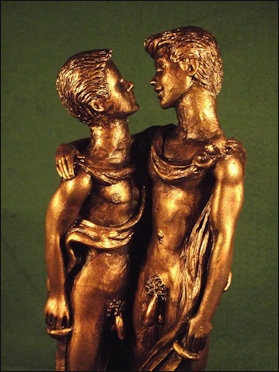
Modern interpretation of the Sacred Band of Thebes
Edward Carpenter wrote in "Ioläus": "The Sacred Band of Thebes, or Theban Band, was a battalion composed entirely of friends and lovers; and forms a remarkable example of military comradeship. The references to information technology in afterward Greek literature are very numerous, and in that location seems no reason to doubt the general truth of the traditions concerning its formation and its complete annihilation by Philip of Macedon at the boxing of Chaeronea (B.C. 338). Thebes was the last stronghold of Hellenic independence, and with the Theban Ring Greek liberty perished. Simply the mere beingness of this phalanx, and the fact of its renown, show to what an extent comradeship was recognized and prized as an institution amidst these peoples. [Source: Edward Carpenter'southward "Ioläus,"1902]
The following account is taken from Plutarch's Life of Pelopidas, Clough'south translation: "Gorgidas, according to some, get-go formed the Sacred Ring of 300 chosen men, to whom as being a guard for the citadel the State allowed provision, and all things necessary for exercise; and hence they were called the urban center band, as citadels of onetime were commonly chosen cities. Others say that it was equanimous of young men attached to each other by personal affection, and a pleasant saying of Pammenes is current, that Homer's Nestor was not well skilled in ordering an regular army, when he advised the Greeks to rank tribe and tribe, and family and family, together, that so 'tribe might tribe, and kinsmen kinsmen aid,' only that he should have joined lovers and their beloved. For men of the same tribe or family unit little value i another when dangers press; only a band cemented together by friendship grounded upon dear is never to be broken, and invincible: since the lovers, ashamed to be base in sight of their dear, and the dear before their lovers, willingly blitz into danger for the relief of one another. Nor tin can that be wondered at since they have more regard for their absent-minded lovers than for others present; as in the instance of the man who, when his enemy was going to kill him, earnestly requested him to run him through the breast, that his lover might not blush to see him wounded in the dorsum. It is a tradition also that Ioläus, who assisted Hercules in his labors and fought at his side, was dearest of him; and Aristotle observes that fifty-fifty in his time lovers plighted their faith at Ioläus' tomb. It is likely, therefore, that this band was called sacred on this account; as Plato calls a lover a divine friend. Information technology is stated that it was never beaten till the battle at Chaeronea; and when Philip after the fight took a view of the slain, and came to the place where the three hundred that fought his phalanx lay expressionless together, he wondered, and understanding that it was the band of lovers, he shed tears and said, ' Perish any man who suspects that these men either did or suffered anything that was base of operations.' \=\
"It was not the disaster of Laius, as the poets imagine, that first gave rising to this grade of attachment among the Thebans, but their law-givers, designing to soften whilst they were young their natural fickleness, brought for case the pipe into great esteem, both in serious and sportive occasions, and gave dandy encouragement to these friendships in the Palaestra, to temper the manner and grapheme of the youth. With a view to this, they did well again to make Harmony, the daughter of Mars and Venus, their tutelar deity; since where forcefulness and courage is joined with gracefulness and winning behavior, a harmony ensues that combines all the elements of society in perfect consonance and guild. \=\
"Gorgidas distributed this sacred Band all through the front ranks of the infantry, and thus made their gallantry less conspicuous; not beingness united in one body, but mingled with many others of inferior resolution, they had no fair opportunity of showing what they could do. But Pelopidas, having sufficiently tried their bravery at Tegyrae, where they had fought alone, and around his own person, never afterward divided them, merely keeping them entire, and as one man, gave them the get-go duty in the greatest battles. For as horses run brisker in a chariot than unmarried, not that their joint force divides the air with greater ease, merely because being matched one against another circulation kindles and enflames their backbone; thus, he thought, brave men, provoking one another to noble actions, would evidence most serviceable and most resolute where all were united together." \=\
Romantic Friendship Among Ancient Greek Soldiers

Spartan warriors
Stories of romantic friendship grade a staple subject of Greek literature, and were everywhere accustomed and prized. Athenaeus wrote: "And the Lacedaemonians [Spartans] offer sacrifices to Love before they go to battle, thinking that safety and victory depend on the friendship of those who stand side by side in the battle array.... And the regiment among the Thebans, which is chosen the Sacred Ring, is wholly composed of mutual lovers, indicating the majesty of the God, equally these men adopt a glorious death to a shameful and discreditable life." [Source: Athenaeus, bk. xiii., ch. 12, Edward Carpenter'due south "Ioläus,"1902]
Ioläus is said to accept been the charioteer of Hercules, and his faithful companion. Every bit the comrade of Hercules he was worshipped beside him in Thebes, where the gymnasium was named subsequently him. Plutarch alludes to this friendship over again in his treatise on Love: "And as to the loves of Hercules, it is difficult to record them because of their number; merely those who recall that Ioläus was one of them practice to this solar day worship and laurels him, and make their loved ones swear fidelity at his tomb." And in the aforementioned treatise: "Consider besides how dear (Eros) excels in warlike feats, and is by no means idle, equally Euripides called him, nor a carpet knight, nor ' sleeping on soft maidens' cheeks.' For a man inspired by Love needs not Ares to assist him when he goes out as a warrior against the enemy, but at the bidding of his own god is ' prepare ' for his friend ' to go through fire and water and whirlwinds.' And in Sophocles' play, when the sons of Niobe are existence shot at and dying, one of them calls out for no helper or assister just his lover. [Plutarch, Eroticus, par. 17]
"And you know of class how it was that Cleomachus, the Pharsalian, fell in battle.... When the war between the Eretrians and Chalcidians was at its height, Cleomachus had come to aid the latter with a Thessalian force; and the Chalcidian infantry seemed strong plenty, but they had bang-up difficulty in repelling the enemy's cavalry. So they begged that loftier-souled hero, Cleomachus, to charge the Eretrian cavalry start. And he asked the youth he loved, who was past, if he would be a spectator of the fight, and he saying he would, and affectionately kissing him and putting his helmet on his caput, Cleomachus, wlth a proud joy, put himself at the head of the bravest of the Thessalians, and charged the enemy'southward cavalry with such impetuosity that he threw them into disorder and routed them; and the Eretrian infantry besides fleeing in consequence, the Chalcidians won a splendid victory. However, Cleomachus got killed, and they show his tomb in the market place at Chalcis, over which a huge pillar stands to this mean solar day." [Source: Eroticus, par. 17, trans. Bohn's Classics.]
And further on in the same: \"And among y'all Thebans, Pemptides, is it not usual for the lover to requite his boylove a complete suit of armor when he is enrolled among the men ? And did not the erotic Pammenes modify the disposition of the heavy-armed infantry, censuring Homer as knowing nada about love, because he drew up the Achaeans in club of battle in tribes and clans, and did not put lover and love together, that so ' spear should be next to spear and helmet to helmet' (lliad, xiii. 131), seeing that dearest is the only invincible full general. For men in battle volition leave in the lurch clansmen and friends, yeah, and parents and sons, but what warrior e'er bankrupt through or charged through lover and love, seeing that when there is no necessity lovers ofttimes brandish their bravery and contempt of life."
Homosexual Life in Athens and Ancient Greece
Paul Halsall wrote in a 1986 graduate schoolhouse paper titled "Homosexual Eros in Early Greece": "Origins of cultural homosexuality are better found in the social life of the 7th and 6th centuries rather than in whatever historical event. Hellenic republic was more than settled than in the eighth and early 7th centuries. Nosotros take evidence of a growing population - the number of graves in Attica increased six-fold [5]- and bigger cities. The position of women was down graded in cities where merely men were citizens. In the cities new social settings grew upwardly for men; in gymnasiums men wrestled and ran naked; the symposium or drinking party became a function of city life, and again it was men just. In this situation homosexuality came to the fore. This seems to have been a period of cultural openness and the Greeks had no revealed books to tell them that homosexuality was wrong. It is an oddity of our culture that men often refuse to acknowledge the beauty of another man. The Greeks had no such inhibitions. They were coming together each other daily in male only settings, women were less an less seen as emotional equals and there was no religious prohibition of the bisexuality every homo is physically equipped to express. At the aforementioned time there was an creative flowering in both poetry and visual arts. A cultural nexus of fine art and homosexual eros was thus established and homosexuality became a standing role of Greek civilisation.

male couples
"Athens is always cardinal to our appreciation of Greek history but we tin can be seriously mistaken if nosotros take homosexuality to be an Athenian addiction or try to explain it in purely Athenian terms. Athens became more peaceful in the 7th and fifth centuries just this was not true of the Peloponnese and similarly at that place may accept been democratisation of civilisation in Athens - but not in Sparta or Macedonia. In that location is in fact evidence that romantic eros was seen as homosexual all over Hellenic republic. Sparta, even with its relatively free women, had homosexual relationships built into the structure of the preparation all young Spartan men received . In other Dorian areas also homosexuality was widely accepted. Thebes saw in the 4th century the creation of a battalion of homosexual lovers - the Sacred Ring. In Crete we have evidence of ritualised abduction of younger by older men.
"Elsewhere Anacreon-'s portrayal of Polycrates' court at Samos, and the history of homosexual lovers of the kings of Macedon confirm the extended appreciation of same sex couplings in Greek society. This being and so, it seems to be methodologically unsound to employ events in Athenian social history to explain the nature of eros in early Greece even if perforce most of our testify comes from there. Once established the link between homosexual eros and art gained wide credence. This is reflected in the cultural production of the archaic menstruum. For poets eros was a major source of subject and inspiration. Solon may exist taken as an instance"
Blessed is the man who loves and subsequently early play
Whereby his limbs are supple made and potent
Retiring to his business firm with vino and song
Toys with a off-white boy on his breast the livelong twenty-four hour period !
"Anacreon, Ibycus, Theognis and Pindar share Solon's tastes. Although poems were dedicated to women what is particular to the archaic flow is the valuing of homosexual over heterosexual eros. Plato'due south speakers in the Symposium hold dearest between men as college than any other grade equally information technology was lover between equals; men were held to be on a moral and intellectual airplane higher than women. I of the most extraordinary features of the period was the homosexualisation of myth. Ganymede was only Zeus' servant in Homer only now became seen as his beloved. The passion of Achilles and Patroclus was similarly cast in sexual terms.
"The acme of homosexual love in Athens came almost at the end of the Persistratid tyranny at Athens. It vicious for a variety of reasons and in that location was certainly no immediate switch to democracy only in afterwards Athenian history two lovers, Aristogeiton and Harmodios were given the credit of bringing downwardly the tyrants. Thucydides makes it articulate that what happened was that Hipparchus, the brother of the tyrant Hippias, was killed because he fabricated a laissez passer at Harmodios and when rejected proceeded to victimise his family unit [8]. Thucydides regards all this every bit slightly sordid, although information technology has been suggested his motives in rubbishing the tyrannicides was to promote the Alcmeonids as founders of Athenian democracy [9]. Whatever actually happened an extraordinary cult of the two lovers grew upward in Athens with their descendants being given state honours such equally front seats at the theatre even at the height of radical democracy when such honours were frowned upon. In Athens at to the lowest degree this cult was used repeatedly to give kudos to homosexual couples and what they could achieve for club.
"The theme was exploited philosophically by Plato. In the Symposium he applies the terminology of procreation to homosexual dearest and says that, while information technology does not produce children information technology brings forth beautiful ideas, art and actions which were eternally valuable. Although Plato visualises relationships in lover-beloved terms his philosophy makes it clear that reciprocity was expected betwixt the lovers.
Homosexual Relations in Ancient Greece
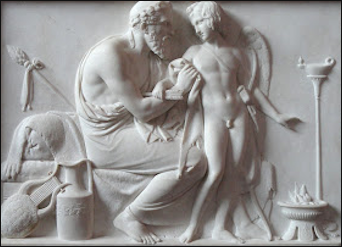
Greek poet Anacreon and his lover
Paul Halsall wrote in a 1986 graduate school newspaper titled "Homosexual Eros in Early Greece": "Poetry, pottery and philosophy exit no doubt equally to the acceptability of homosexual eros. But how much information technology was valued is much harder to estimate. For Athens the all-time bear witness comes in Pausanias' spoken communication in Plato's Symposium. Here Pausanias makes information technology clear that a lover in full flight was canonical of by Athenians, who had expectations of how a lover should prove his dear. These included sleeping in his beloved's doorway all night to evidence his love. The other side of the story was that fathers were- non at all nifty on their sons being pursued and took steps to preserve their son's guiltlessness . Here we take a case of the male person/female double standard being applied to homosexual affairs. The conventional attitude was that it was proficient to exist a lover but not to be passive. A boy just remained respectable if he gave into a lover slowly and fifty-fifty then he could not allow any public compromise of his masculinity. Passivity was seen equally essentially unmasculine. This ambiguity continues in Athenian history and the Timarchus prosecuted by Aischines in 348 faced as the major charge an allegation that he had enjoyed passivity and thus put himself in the aforementioned position equally a prostitute. Away from Athens the thing is non quite so clear. In Sparta boys were encouraged to take lovers, in Crete in that location was a ritual of abduction and the beloved side of the couples in Thebes' Sacred Ring were not castigated as unmasculine. Homosexual eros was valued in art, in philosophy, in heroic couples and as function of a boys education. What did worry Athenians at least was when conventions were not kept to and masculinity was compromised.
"If homosexual relationships were simply known as short affairs they are strangely at odds with the elevated nature of eros described by Plato who seems to envisage a lifelong joint search for truth. We should not be misled past statues of erstwhile father Zeus abducting immature and innocent Ganymede. Although it was accepted that in that location should be an age difference between lovers this need not be very great. Vase paintings often evidence youths with boys where the erastes/eromenos distinction is maintained only without much disparity in years. Anal intercourse when shown is virtually always between coevals. Aristophanes in the Symposium spins a myth of eros existence the upshot of a single person cut in half trying to find and re-unite with the other half; this more or less implies an expectation that lovers would not be to disparate in age. While not ruling out a decade or so in age divergence, we must let that if a youth was going to form a relationship involving sex with another man he would want and adore somebody in their prime number. The realities of the army and gymnasium would ensure a limited age distribution also - the very young nor very old would not be either numerous or admired for their prowess. Homosexual affairs then would take identify between men of comparable age and some of them lasted many years - Agathon with his lover in the Symposium, Socrates in his relationship with Alcibiades, who broke all the rules past chasing an older man, and the couples in Thebes' regular army are all testimony to homosexual 'marriages'. Information technology is however non articulate if affairs continued after either party married. Other men were for emotional relationships just alliances and children depended on women. The historic period of union was 30, by convention, and affairs may take reached natural conclusions at that historic period. We accept no prove either way.
"Every bit well as conventions on age at that place were accepted practices in sex, exhibited very well on vase paintings. Information technology is I suggest simply unreasonable to believe that 16-xx year olds, every bit portrayed on vases, had no sexual response and only unwillingly allowed themselves to be penetrated inter-crurally without whatsoever pleasure. Hither nosotros take a example of conventions far removed from actuality. While keeping in listen that we hear of no relationships without the active-passive roles, it is clear that writers in contrast to painters expected homosexual sex to include anal penetration; Aristophanes uses the epithet "europroktos"(wide-arsed) for men with a lot of experience of being penetrated. Greek convention decried the passive partner in penetrative intercourse and we may assume that both partners took intendance that their private pleasures were not made public. It is useful to think that Greek morals were concerned with what was known not what was done and unlike cases such as dishonouring a guest there was no divine sanction against sexual pleasures, which indeed the gods seemed to relish in affluence. In short I recollect Aristophanes' sense of humour is more than reliable than vases. Penetration was important to the Greek idea of what sex activity was which was why their major distinction was between agile and passive rather than 'straight' or 'gay'. What went on backside closed doors probably did not accord with convention."
Male person Aboriginal Greek Couples
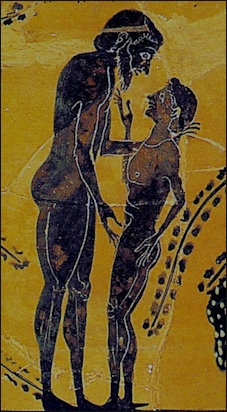
Paul Halsall wrote: "There is no incertitude that classical Greek literature ofttimes presents a distinct model of homosexual eros. The proposed relationship is between a an older human being (the lover or erastes) and a younger man (the beloved or eromenos). This ideal has much influenced discussion of the subject, and has lead some commentators to limit the connections betwixt ancient Greek homosexually agile men and modernistic "homosexuals": one-time-style historians emphasized that "homosexuality" was a phenomenon of the upper classes, opposed to republic, and get less mutual in the more "heterosexual" Hellenistic period; modern "cultural historians" have argued repeatedly that the "homosexual" (conceived as an individual [or "subject"] defined past his or her sexual orientation) is a modern "social construction".
It is worthwhile retaining such considerations when studying the texts well-nigh homosexuality in Ancient Hellenic republic: the proposers of these ideas are serious scholars whose views need respect. Still, such views can go a rigid orthodoxy. The fact of the matter is that at that place are all sorts of texts relating to homosexuality surviving from Ancient Hellenic republic, and many of these texts reveal that the literary ideal was not indicative of much practice; nor, even, the only platonic of homosexual dear.
Here, then are textual references for long-term (in some cases life-long) homosexual relationships in the Greek texts; 1) Orestes and Pylades: Orestes is the hero of the Oresteia cycle. He and Pylades were bywords for faithful and life-long love in Greek culture, encounter Lucian (2nd C. CE): Amores or Affairs of the Heart, #48. ii) Damon and Pythias: Pythagorean initiates, see Valerius Maximus: De Amicitiae Vinculo. 3) Aristogeiton and Harmodius, credited with overthrowing tyranny in Athens, see Thucydides, Peloponnesian War, Volume half dozen. four) Pausanias and Agathon: Agathon was an Athenian dramatist (c. 450-400 BCE). He was famous as an "effeminate" homosexual. It was in his house that the Dinner Party of Plato's Symposium takes identify. encounter Plato: Symposium 193C, Aristophanes: Thesmophoriazusae. 5) Philolaus and Diocles -Philolaus was a lawgive at Thebes, Diocles an Olympic Athlete, see Aristotle, Politics 1274A. 6) Epaminondas and Pelopidas: Epaminondas (c.418-362 BCE) led Thebes in its greatest days in the fourth century. At the boxing of Mantinea (385 BCE) he saved the life of his life long friend Pelopidas, encounter Plutarch: Life of Pelopidas. 7) Members of the Sacred Band of Thebes, see Plutarch: Life of Pelopidas. 8) Alexander the Great and Hephasteion, Atheaneus, The Deinosophists Bk 13.
Aristogeiton and Harmodius, Gay Lovers Who Overthrew the Athenian Tyrrany
During the Peloponnesian War, an group of vandals went around Athens knocking the phalluses off Hermes - the steles with the head and phallus of the God Hermes which were often outside houses. This incident, which lead to suspicions of the Athenian full general Alciabiades, provided Thucydides with a spring board to recount the story of Harmodius and Aristogeiton, two homosexual lovers credited past the Athenians with overthrowing tyranny.
Thucydides wrote in "The History of the Peloponnesian War," 6th. Book (ca. 431 B.C.): ""Indeed, the daring activeness of Aristogiton and Harmodius was undertaken in consequence of a dear thing, which I shall relate at some length, to bear witness that the Athenians are not more accurate than the residue of the earth in their accounts of their own tyrants and of the facts of their own history. Pisistratus dying at an advanced historic period in possession of the tyranny, was succeeded by his eldest son, Hippias, and not Hipparchus, every bit is vulgarly believed. Harmodius was and then in the flower of youthful beauty, and Aristogiton, a citizen in the middle rank of life, was his lover and possessed him. Solicited without success by Hipparchus, son of Pisistratus, Harmodius told Aristogiton, and the enraged lover, afraid that the powerful Hipparchus might have Harmodius by force, immediately formed a design, such as his condition in life permitted, for overthrowing the tyranny. In the concurrently Hipparchus, after a second solicitation of Harmodius, attended with no better success, unwilling to utilize violence, arranged to insult him in some covert way. Indeed, generally their government was not grievous to the multitude, or in any mode odious in practice; and these tyrants cultivated wisdom and virtue as much as any, and without exacting from the Athenians more than a twentieth of their income, splendidly adorned their urban center, and carried on their wars, and provided sacrifices for the temples. For the rest, the city was left in total enjoyment of its existing laws, except that care was always taken to have the offices in the hands of some one of the family. Among those of them that held the yearly archonship at Athens was Pisistratus, son of the tyrant Hippias, and named subsequently his grandad, who dedicated during his term of office the altar to the twelve gods in the market-identify, and that of Apollo in the Pythian precinct. The Athenian people afterwards built on to and lengthened the chantry in the market-place, and obliterated the inscription; but that in the Pythian precinct tin can still be seen, though in faded letters, and is to the post-obit effect: "Pisistratus, the son of Hippias,/ Sent upward this tape of his archonship/ In precinct of Apollo Pythias. [Source: Thucydides, "The History of the Peloponnesian War," 6th. Book, ca. 431 B.C., translated by Richard Crawley]
"That Hippias was the eldest son and succeeded to the regime, is what I positively assert as a fact upon which I take had more verbal accounts than others, and may be also ascertained by the following circumstance. He is the only one of the legitimate brothers that appears to accept had children; as the chantry shows, and the colonnade placed in the Athenian Acropolis, commemorating the criminal offence of the tyrants, which mentions no child of Thessalus or of Hipparchus, simply five of Hippias, which he had past Myrrhine, daughter of Callias, son of Hyperechides; and naturally the eldest would have married commencement. Once more, his name comes start on the colonnade after that of his male parent; and this likewise is quite natural, equally he was the eldest later on him, and the reigning tyrant. Nor can I ever believe that Hippias would accept obtained the tyranny and so hands, if Hipparchus had been in power when he was killed, and he, Hippias, had had to found himself upon the same day; but he had no doubt been long accustomed to overawe the citizens, and to exist obeyed by his mercenaries, and thus not only conquered, but conquered with ease, without experiencing any of the embarrassment of a younger brother unused to the practice of potency. It was the sorry fate which made Hipparchus famous that got him as well the credit with posterity of having been tyrant.
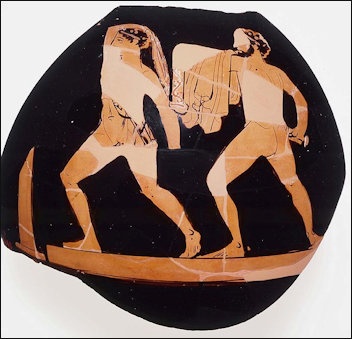
Harmodius and Aristogeiton
"To return to Harmodius; Hipparchus having been repulsed in his solicitations insulted him as he had resolved, by beginning inviting a sister of his, a young girl, to come and carry a basket in a sure procession, and then rejecting her, on the plea that she had never been invited at all owing to her unworthiness. If Harmodius was indignant at this, Aristogiton for his sake now became more exasperated than e'er; and having arranged everything with those who were to join them in the enterprise, they merely waited for the great banquet of the Panathenaea, the sole day upon which the citizens forming role of the procession could run into together in arms without suspicion. Aristogiton and Harmodius were to begin, merely were to be supported immediately by their accomplices against the bodyguard. The conspirators were non many, for better security, besides which they hoped that those not in the plot would be carried abroad by the instance of a few daring spirits, and utilise the arms in their hands to recover their liberty.
"At final the festival arrived; and Hippias with his bodyguard was outside the city in the Ceramicus, arranging how the different parts of the procession were to proceed. Harmodius and Aristogiton had already their daggers and were getting ready to human activity, when seeing one of their accomplices talking familiarly with Hippias, who was easy of access to every one, they took fear, and concluded that they were discovered and on the indicate of being taken; and eager if possible to exist revenged outset upon the homo who had wronged them and for whom they had undertaken all this hazard, they rushed, as they were, inside the gates, and meeting with Hipparchus past the Leocorium recklessly fell upon him at once, infuriated, Aristogiton by love, and Harmodius by insult, and smote him and slew him. Aristogiton escaped the guards at the moment, through the crowd running up, but was afterwards taken and dispatched in no merciful way: Harmodius was killed on the spot.
"When the news was brought to Hippias in the Ceramicus, he at in one case proceeded non to the scene of activity, but to the armed men in the procession, before they, beingness some distance away, knew anything of the matter, and composing his features for the occasion, so as not to betray himself, pointed to a certain spot, and bade them repair thither without their arms. They withdrew accordingly, fancying he had something to say; upon which he told the mercenaries to remove the arms, and in that location and then picked out the men he thought guilty and all plant with daggers, the shield and spear existence the usual weapons for a procession.
"In this way offended love commencement led Harmodius and Aristogiton to conspire, and the alarm of the moment to commit the rash activity recounted. After this the tyranny pressed harder on the Athenians, and Hippias, now grown more fearful, put to death many of the citizens, and at the same time began to turn his optics abroad for a refuge in case of revolution. Thus, although an Athenian, he gave his daughter, Archedice, to a Lampsacene, Aeantides, son of the tyrant of Lampsacus, seeing that they had great influence with Darius. And at that place is her tomb in Lampsacus with this inscription: "Archedice lies cached in this earth,/ Hippias her sire, and Athens gave her birth; / Unto her bosom pride was never known." Though girl, wife, and sis to the throne. Hippias, subsequently reigning three years longer over the Athenians, was deposed in the fourth by the Lacedaemonians (Spartans) and the banished Alcmaeonidae, and went with a safe conduct to Sigeum, and to Aeantides at Lampsacus, and from thence to Male monarch Darius; from whose court he set out 20 years subsequently, in his old historic period, and came with the Medes to Marathon."
Image Sources: Wikimedia Commons, The Louvre, The British Museum
Text Sources: Net Ancient History Sourcebook: Greece sourcebooks.fordham.edu ; Internet Ancient History Sourcebook: Hellenistic Globe sourcebooks.fordham.edu ; BBC Ancient Greeks bbc.co.uk/history/ ; Canadian Museum of History historymuseum.ca ; Perseus Projection - Tufts University; perseus.tufts.edu ; MIT, Online Library of Liberty, oll.libertyfund.org ; Gutenberg.org gutenberg.org Metropolitan Museum of Art, National Geographic, Smithsonian magazine, New York Times, Washington Post, Los Angeles Times, Live Science, Notice magazine, Times of London, Natural History magazine, Archaeology mag, The New Yorker, Encyclopædia Britannica, "The Discoverers" [∞] and "The Creators" [μ]" by Daniel Boorstin. "Greek and Roman Life" by Ian Jenkins from the British Museum.Fourth dimension, Newsweek, Wikipedia, Reuters, Associated Printing, The Guardian, AFP, Lonely Planet Guides, "World Religions" edited past Geoffrey Parrinder (Facts on File Publications, New York); "History of Warfare" by John Keegan (Vintage Books); "History of Art" past H.W. Janson Prentice Hall, Englewood Cliffs, N.J.), Compton's Encyclopedia and various books and other publications.
Last updated Oct 2018
Source: https://factsanddetails.com/world/cat56/sub406/entry-6202.html
0 Response to "Hellenic Literature and Art Offer Ample Evidence of Bisexual and Homosexual Relationships"
Post a Comment